User size & time on feet
WHY IT MATTERS
As outlined in our guide on static standing work, anti-fatigue matting supports the body through controlled compression under load, helping keep muscles active and reduce fatigue over time. To maintain this effect throughout the day, the mat must be correctly matched to both the user and the time on feet.
The principle:
Gravity is constant. A heavier operator, or any operator standing in the same spot for a long period, compresses a mat further than a lighter operator doing a shorter shift. A mat that is fully compressed offers no more cushioning or postural activation than the hard floor beneath it. The foam is simply displaced. Specifying by user weight and time on feet ensures the mat maintains its working range throughout the shift.
WHAT THIS MEANS IN PRACTICE
Shared and rotating workstations
Where multiple operators use the same station across a day or shift, the heaviest regular user determines the specification. A mat correctly sized for a lighter operator may be fully compressed before the end of the shift for a heavier colleague at the same station.
Part-time and intermittent standing
Where an operator is regularly away from the mat — attending to other tasks, moving between stations, or seated for part of their shift — a W1 may be appropriate even for a larger operator, because the mat has recovery time between loading periods.
When in doubt, specify up
A mat specified one level above the minimum requirement for the user performs correctly and lasts longer. A mat specified below requirement loses its effect before the shift ends. The cost difference between series is small relative to the impact of an incorrect specification.
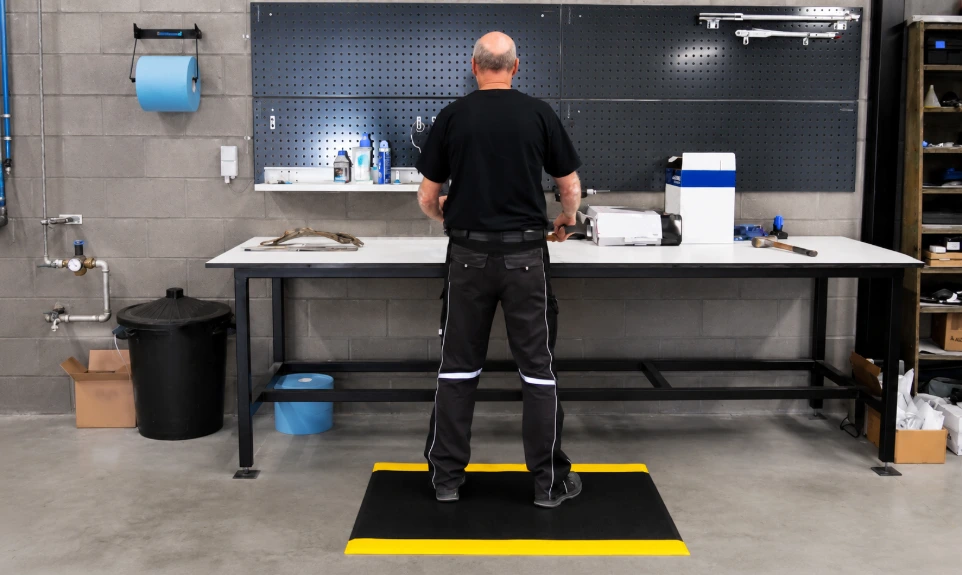
Rebourne® W1 Series
For frequent, yet non continuous standing tasks.
Recommended for small to medium size users
Standing up to 3 hours/day
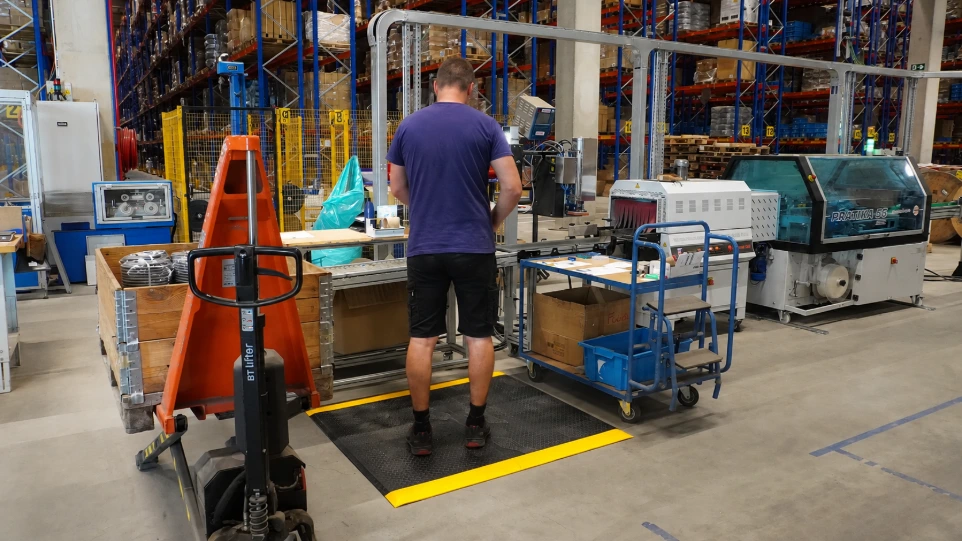
Rebourne® W2 Series
For frequent daily standing work.
Recommended for medium to large size users
Standing up to 8 hours/day

Rebourne® R Series
For continuous standing work.